
Porcelain veneers (also called porcelain facings) are thin shells of porcelain, about 0.2 to 0.5 mm thick. The veneer is bonded permanently to the outer surface of the tooth with a special porcelain adhesive, so that it fits snugly over the whole tooth and looks as natural as possible.
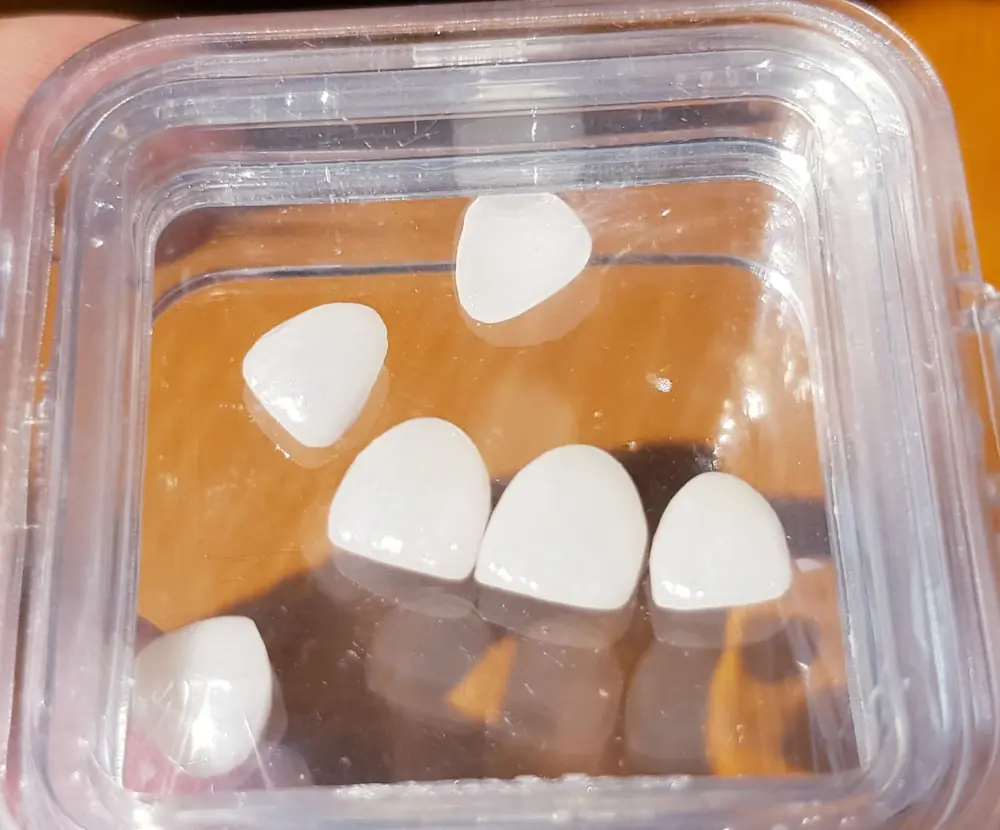
Veneers are seen as a new breakthrough in cosmetic dentistry for people who do not want much of their teeth filed down but still want to turn stained, yellowed, uneven or gapped teeth into an even, bright white smile.
When should you get porcelain veneers?
Today many patients choose porcelain veneers because they preserve the natural tooth, with very little or even no filing. Veneers are bonded onto the natural enamel. However, this method is not suitable for every case.
Cases where veneers are a better choice than crowns:
- Teeth with chips that are not too large.
- Gaps between teeth of no more than 2 mm.
- Teeth that are even but stained or yellow, and you want them whiter.
- The shape of some teeth needs correcting: small teeth, or you want a pair of cute “bunny teeth” for a distinctive look…
Porcelain crowns or veneers: how to choose?
Usually, the dentist decides whether you should get porcelain crowns or veneers based on your specific case. However, if you want to work out for yourself which method suits you, consider the factors below:
Technical differences
Porcelain crowns: the tooth needs to be filed down by about 0.6 to 2 mm depending on its surface. Crowns restore teeth that have lost structure or had a root canal, rebuild the tooth, replace missing teeth, and improve the look of the front teeth when veneers are not an option (poor bite, severely crowded teeth…)
Porcelain veneers: the tooth only needs to be filed down by 0.3 to 0.5 mm, and in some cases not at all. Veneers only cover the outer surface, so they cause no disruption or discomfort. However, veneers are not possible in every case. Specifically, veneers cannot replace missing teeth and are not suitable for a poor bite, severely crowded teeth, people who often eat hard foods, or people with bad habits such as chewing pens or grinding their teeth…
Treatment time
Both crowns and veneers take about 2 appointments, about 2 to 4 days apart per tooth. You may also come back for one more appointment to adjust your bite, so that chewing feels easier and more comfortable.
Lifespan
When done with the right technique and for the right case, both methods last about equally long. They can last up to 15 years or even a lifetime if you take good care of them and have regular maintenance every 4 to 6 months.
Biological aspects
Porcelain veneers need no filing or very little, 0.3 to 0.5 mm, so they preserve as much tooth tissue as possible, do not affect the living pulp of the tooth, and the tooth is stronger and healthier afterwards.
Appearance
Porcelain veneers are only 0.3 to 0.5 mm thick and let the color of the natural tooth show through, so the color looks exactly like a natural tooth. However, they are not suitable for teeth that are dark gray or heavily stained.
Porcelain crowns create a color very close to natural teeth. If you choose high-end metal-free porcelain crowns, the color looks just like your natural teeth.